Press Release · Datatel
Datatel Highlights Why Conversational AI Payment Architecture Deserves Greater Executive Attention
Distributed by DataCult · Originally issued via PRUnderground
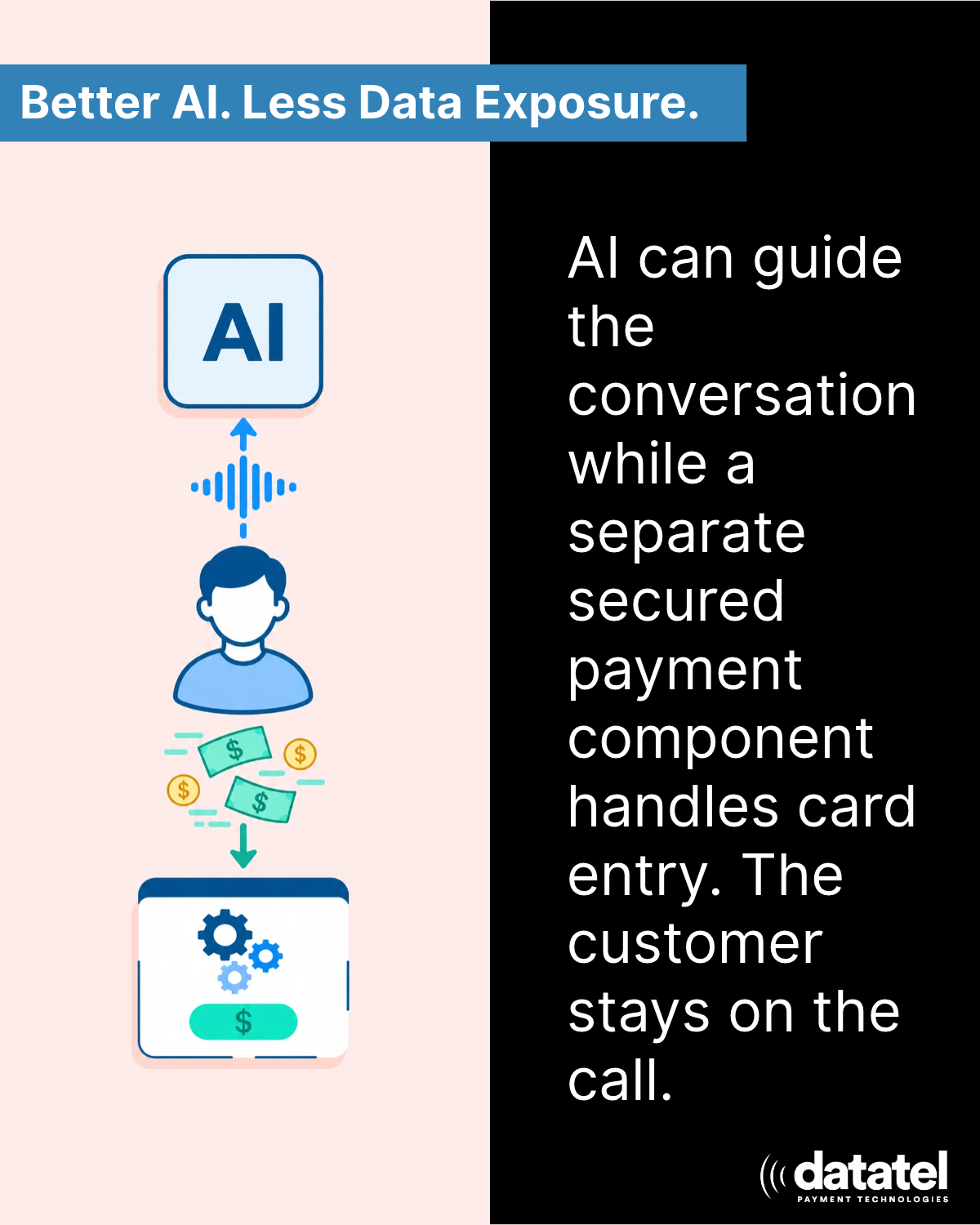
Datatel highlights why businesses adopting conversational AI should evaluate payment architecture to protect sensitive cardholder data and reduce unnecessary exposure.
Toronto, Canada (PRUnderground) November 22nd, 2026
Datatel Communications Inc./Datatel Inc., a provider of IVR Payments and secure payment automation technology, is highlighting why organizations introducing conversational AI into their customer service should examine whether those systems need access to sensitive payment card information.
As businesses deploy AI-powered voice assistants to answer customer questions, retrieve account information, and support payment interactions, the movement of cardholder data through these environments is becoming an important architectural consideration.
A conversational AI assistant may help a customer identify an account, confirm an outstanding balance, and initiate a payment without needing to receive the customer's credit card details.
However, the AI environment can extend beyond the underlying language model. Depending on the implementation, speech recognition, call recordings, transcripts, logging, analytics, and integrated applications may all be involved in the customer interaction.
The PCI Security Standards Council's September 2026 information supplement, Security Considerations for AI Systems, addresses the security implications of AI deployments within environments subject to PCI standards.
The guidance explains that AI systems receiving or accessing account data must be evaluated under applicable PCI DSS requirements. It also discusses limiting unnecessary access, using protective technologies where appropriate, and validating isolation controls.
For organizations introducing AI into customer payment operations, one architectural option is to separate the conversation from sensitive data handling.
Under this approach, AI guides the customer while a dedicated, securely controlled payment component captures and processes card information. The customer remains connected, and the AI receives only the information necessary to continue the interaction.
This separation may help reduce unnecessary exposure, but it does not automatically remove AI systems from PCI DSS scope. Actual connectivity, permissions, access to decryption or detokenization capabilities, and the effectiveness of isolation controls must be assessed.
Through its Payment Flow Intelligence Framework™, Datatel considers five dimensions: how customers pay, where people are involved, where money is slowed down, where risk is created, and whether the process can scale.
These questions help leadership teams distinguish between functions that benefit from conversational AI and responsibilities that can remain within dedicated payment systems.
For CIOs, CFOs, and business leaders, the practical question is not simply whether AI can participate in a payment interaction. It is whether the architecture gives AI only the information and capabilities necessary to perform its intended function.
Datatel encourages organizations to examine the complete payment workflow before expanding AI capabilities.
Learn more in Datatel's article, Does Your AI Really Need to See the Customer's Credit Card? : https://www.datatel-systems.com/article/conversational-ai-payment-security/
Press Contact
Name: Raquel Leon Phone: 800-831-6660 Email: Contact UsAbout Datatel
Datatel helps organizations understand and improve how money and payments move through their businesses. Through payment technology, workflow automation, and payment process modernization, Datatel supports organizations seeking to improve customer experiences, operational efficiency, and payment security.